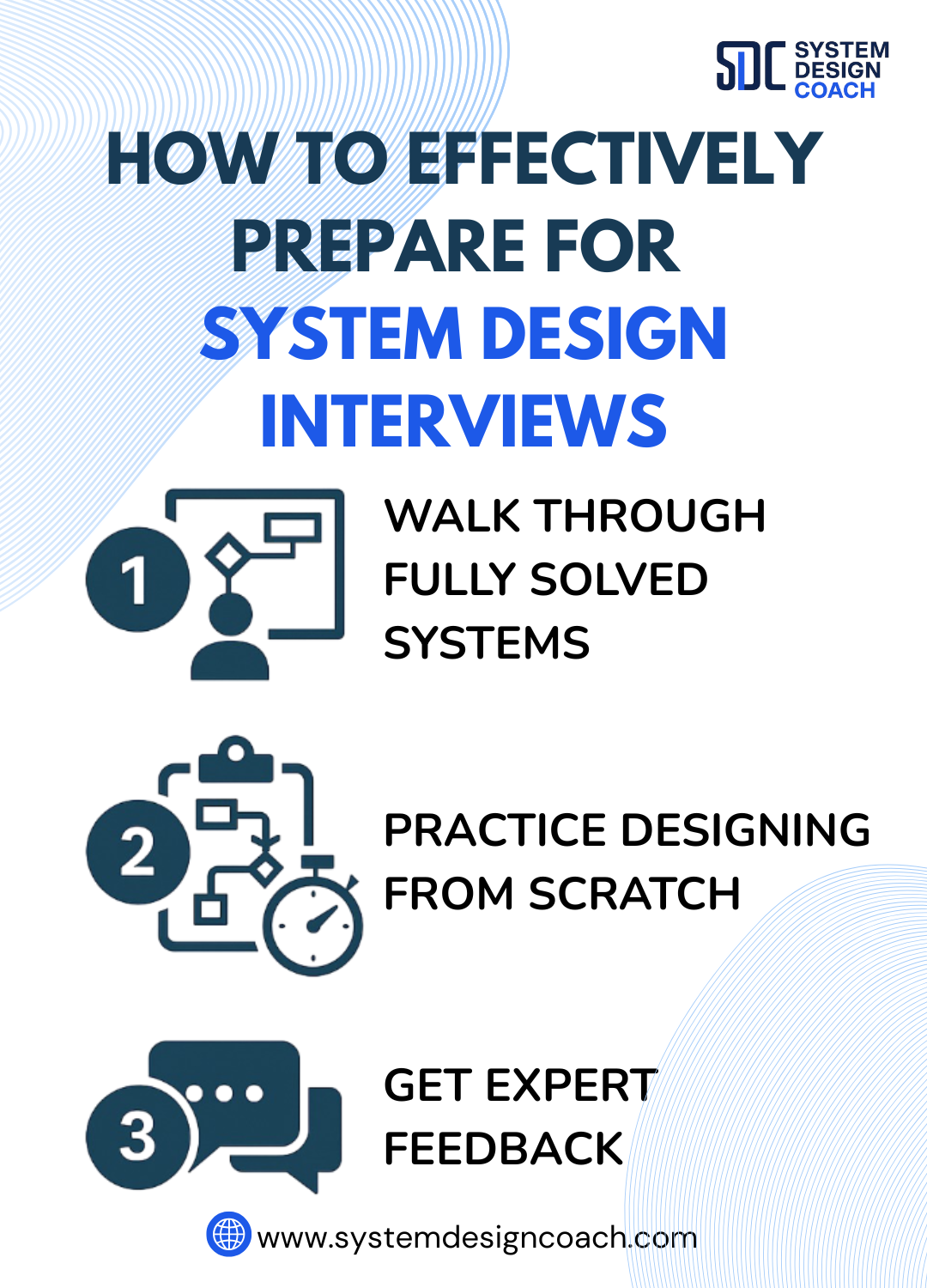
Preparing for system design interviews is challenging even for experienced engineers. These interviews ask you to design end-to-end systems such as an e-commerce site, ride-sharing platform, or real-time messaging service. Most of us don't build entire systems from scratch in our day-to-day work. Instead, we typically own a slice of a much larger architecture.
On top of that, system design interviews come with a strict time constraint: you are expected to define requirements, make trade-offs, propose an architecture, and explain your reasoning in 45–60 minutes. In real life, we often spend days or weeks researching, diagramming, and iterating on a design.
Because of these differences, effective preparation requires more than general engineering experience. Navigating a 45–60 minute design session is a specific skill.
So, what is an effective way to master a new skill? In his book, Get Better at Anything, Scott H. Young outlines a three-step process:
- Observe how an expert does it.
- Practice it yourself.
- Seek feedback to improve your performance.
After coaching hundreds of engineers, I’ve found that the same framework works really well for system design interview preparation. Let's break it down.
1. Observe an expert designing an end-to-end system
Many candidates start by going over dozens of concepts, such as consistent hashing, sharding, and replication. However, concepts in isolation don't help unless you understand when and how to apply them. This is why many candidates struggle to put the pieces together in a real interview.
A more effective approach is to walk through a fully solved system end-to-end and learn the underlying concepts as they naturally arise. This gives you a clearer sense of how different components connect in real-world architectures.
Select a set of representative problems to study across broad categories of systems, such as file sharing services, streaming platforms, e-commerce sites, social media feeds, and messaging platforms, so you get exposure to different architectural patterns.
There are many excellent articles and recorded resources available today, and many creators actively respond to comments. If you are unsure about a concept, you can often ask questions and get helpful explanations. However, this learning process is inherently passive and often has a slow feedback loop.
You can turn this into active learning by seeking out an interactive environment. Whether it's a study group or a live course, the ability to interrupt and ask why a decision was made the moment it happens clarifies misconceptions in real-time. This accelerates your learning significantly, turning passive observation into active mastery.
2. Practice on your own
Once you've reviewed a set of end-to-end designs, it is time to move from "knowing" to "doing" by practicing on your own. Break your practice into two stages:
Stage A: Replicate an existing design
Take a system you've already seen solved end-to-end. Keep the diagram open for reference and recreate it using a tool like Excalidraw.
Why this works:
- Research shows that at the early stage, when dealing with many new concepts, replicating a worked solution is one of the most effective ways to build a new skill (the worked-example effect, John Sweller).
- Recreating the design forces you to engage with details you might otherwise skim over. This process helps you internalize the flow, components, and trade-offs while also building muscle memory with diagramming tools.
Stage B: Design a system from scratch with a timer
Once you've replicated a few systems, pick one of the design prompts and practice it under interview-like conditions without seeing any reference materials:
- Set a 45–50 minute timer, depending on the amount of time you would get in actual interviews.
- Draw the diagram and explain your design and reasoning out loud as if you are in an actual interview.
- Note where you stumble or run out of time.
This will help you identify the concepts you haven't fully mastered and how well you are managing your time.
For practicing under interview-like conditions, start with introductory problems, gradually move to more complex problems, and then challenge yourself with unseen problems.
3. Get feedback from an experienced interviewer
After you've observed good examples and practiced on your own, the final step is getting feedback from an experienced interviewer. This could be a friend, colleague, or mentor. Alternatively, you could book a mock interview session through a professional coaching service if you prefer more structured evaluation.
Experienced interviewers can:
- Identify blind spots in your approach.
- Test whether you can defend trade-offs.
- Probe areas you may have overlooked.
For high-stakes interviews, doing a mock interview 1–2 weeks before your actual interview is ideal. Doing mock sessions 1–2 days in advance doesn't usually leave enough time to absorb the feedback and make meaningful improvements.
Giving yourself 1–2 weeks allows you to refine your structure, address gaps, rerun your practice problems, and walk into the real interview with confidence.
In summary
System design interviewing is a skill; one you can learn and improve with the right structure. If you focus on learning through high-quality examples, deliberate practice, and receiving expert feedback, you will see rapid improvement in both confidence and performance.